_edited.png)
MINORIA: Protocol
Monika Turczyńska
Conceptual Installation
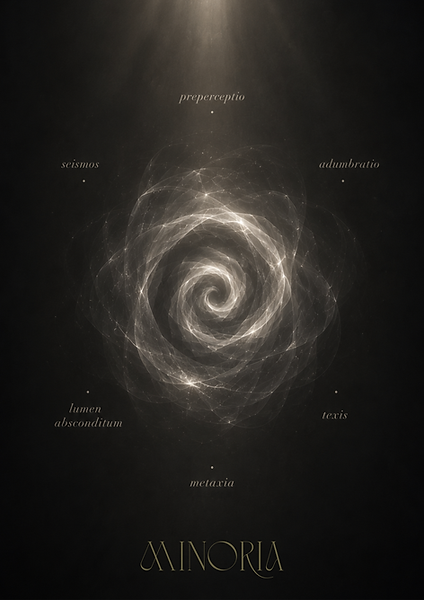
MINORIA: PROTOCOL unfolds as a curatorial installation in which perception, image and access are simultaneously suspended and reconfigured.
MINORIA operates as a non-linear, pulsating field in which forms emerge, condense, withdraw and return. Rather than unfolding through a sequence of discrete exhibitions, it articulates successive and recurring configurations of this field.
Each chapter records one of these configurations.
MINORIA: PROTOCOL marks a shift within this structure.
The work is no longer presented primarily as an image or object, but as a system — a set of conditions through which perception is organised and destabilised.
The exhibition takes the form of a curatorial installation.
Composed of modules, definitions, observational procedures, error structures and symbolic equations, it adopts the language of technical and quasi-scientific description. This language suggests precision, control and the possibility of capture.
Yet what it addresses cannot be stabilised.
The protocol does not resolve this contradiction.
It sustains it.
The attempt to define becomes part of the work itself — not as failure, but as exposure. The system does not capture the field; it reveals the limits of capture.
Within this framework, the image does not stabilise.
It appears only as trace — something sensed, interrupted and partially withdrawn.
What emerges here cannot be fully described within a binary logic of presence and absence. Something either is, or is not — this remains the dominant structure of interpretation.
MINORIA operates outside this division.
It introduces a field of emergence — a condition in which something is not yet fully present, yet cannot be described as absent.
This intermediate state — metaxia — is not a transition between two stable conditions, but a space of continuous formation.
Here, the image does not exist as a defined entity.
It persists as potential — as something already sensed, but not yet stabilised.
The field of MINORIA is frequently overlooked precisely because it does not conform to the logic of completion.
Perception must therefore be displaced.
Observation requires delay.
Immediate recognition interrupts the field.
Attention shifts from the centre to the margin, from the object to the interval, from form to the conditions that allow form to emerge.
Within this system, error is not treated as failure, but as a point of contact — a moment in which the field becomes perceptible.
Error does not disrupt the system.
It reveals it.
In its current state, MINORIA operates at the surface.
The gallery remains physically closed.
This is not a logistical condition, but a structural one.
The work no longer unfolds within the interior of the space, but at its threshold — through the window, reflection, obstruction and delay. The surface replaces the interior as the primary site of experience.
The viewer does not enter the exhibition.
The exhibition alters the conditions of seeing.
This position also resonates within a broader exhibition context.
While contemporary discourses frequently engage with notions of subtlety, marginality and instability, they are often articulated through intensified and highly visible forms of presentation.
MINORIA: PROTOCOL does not oppose this condition directly.
It displaces it.
Instead of amplifying visibility, it withholds it.
Instead of declaring, it suspends.
Instead of presenting difference, it reorganises the conditions under which it may be perceived.
MINORIA: PROTOCOL does not mark a conclusion.
It is a temporary stabilisation within a pulsating field — a state in which access is withheld while the work remains active at the level of perception.
The exhibition remains incomplete by design.
What remains unmeasured persists.
A Space Gallery, Venice
June 17, 2026
July 1, 2026


Artist / Author: Monika Turczyńska
Curator: Monika Turczyńska
Project: MINORIA
Chapter: PROTOCOL (M-X/00)
Venue: A Space Gallery, Venice
Year: 2026